
 By Saba Aziz
Quick answer: how can yoga help your balance?
Standing yoga poses train the muscles, joints and attention you use to stay steady. Practised regularly and with support when you need it, they can help you feel more stable on your feet. This yoga for balance and stability routine takes about ten minutes, uses a wall or chair for support, and suits beginners.
Key takeaways
- Practise next to a wall or a sturdy chair so you can reach out for support.
- Start with both feet on the floor, then progress to one-leg poses.
- Look at a fixed point to help you steady yourself.
- Move slowly and breathe normally.
- If you have dizziness, inner-ear problems or a history of falls, ask a professional before you start.
Six balance poses to learn
| Pose | How to do it | Make it easier |
|---|---|---|
| Mountain pose | Stand tall, feet hip-width apart, weight even through both feet, arms by your sides. | Stand with your back near a wall |
| Chair pose | Bend your knees and sit your hips back as if sitting on a low chair, arms forward. | Use a shallower bend |
| Standing knee lift | Shift your weight to one foot and lift the other knee to hip height. | Keep your toes on the floor or hold a chair |
| Tree pose | Place one foot on your ankle or calf (not the knee) and hold your hands at your chest. | Keep your toes on the floor and hold a wall |
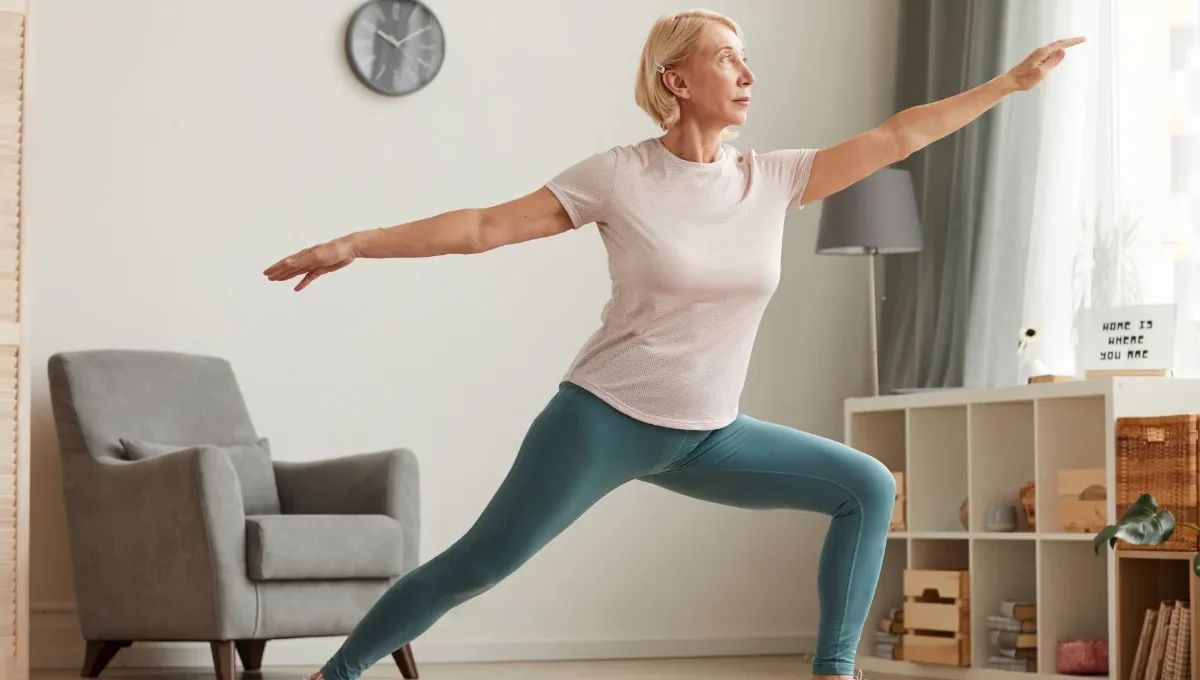
| Warrior II | Step your feet wide, bend the front knee and reach your arms out. | Use a smaller stance |
| Heel-to-toe walk | Walk in a straight line with the heel of one foot touching the toes of the other. | Walk next to a wall |
A 10-minute routine
| Step | Time |
|---|---|
| Mountain pose and slow breathing | 1 minute |
| Chair pose | 3 rounds of 20 seconds |
| Standing knee lift | 30 seconds each side |
| Tree pose | 30 seconds each side |
| Warrior II | 30 seconds each side |
| Heel-to-toe walk | 2 minutes |
| Gentle forward fold and rest | 1 minute |
How to progress
- Hold each pose a little longer, by about five seconds at a time.
- Move from touching a wall to holding it with just a finger.
- Practise on a firm surface first, then a slightly softer one such as a thin mat.
- Only try closing your eyes when you are very steady and next to a wall.
A weekly plan
| Day | Plan |
|---|---|
| Monday | 10-minute balance routine |
| Tuesday | Walk or rest |
| Wednesday | 10-minute balance routine |
| Thursday | Easy yoga. See our easy yoga flow |
| Friday | 10-minute balance routine |
| Weekend | Rest, or a walk |
Safety
- Clear the floor of rugs, cables and anything you could trip on.
- Practise barefoot or in non-slip socks, and keep a wall or chair within reach.
- Stop if you feel dizzy, lightheaded or unwell.
- Ask a healthcare professional first if you have balance problems, a history of falls, osteoporosis, pregnancy or an injury.
Common mistakes
- Placing the foot on the side of the knee in tree pose
- Holding your breath
- Looking down at your feet
- Skipping support too early
- Practising when tired or rushed
Frequently asked questions
How often should I practise balance?
Three or four short sessions a week is a good start. Even two minutes a day can help.
Will yoga prevent falls?
Balance practice can help you feel steadier, but it cannot guarantee you will not fall. A professional can advise you on fall prevention.
Is this suitable for older adults?
Many older adults practise gentle, supported balance work. Ask a professional first, use a wall or chair, and keep poses simple. Our low-impact workouts guide has more gentle options.
What if I wobble a lot?
Wobbling is normal. It means your body is learning. Reduce the difficulty and keep a wall nearby.
Conclusion
Balance improves with regular, gentle practice. Use support, move slowly, progress a little at a time and stop if anything feels wrong. A few minutes several times a week is a good place to start.
About the author
Saba Aziz: Saba Aziz is the publisher of Daily Fitness, a health and fitness blog focused on simple, realistic ways to stay active and look after your wellbeing. Daily Fitness covers cardio, strength training, yoga, recovery, hydration and holistic wellness, with an emphasis on safe progression, reputable sources and habits you can keep. Everything on the site is for general education and is not medical advice, so please speak with a qualified healthcare professional before changing your exercise or nutrition routine. Learn more about Daily Fitness.
Educational note: this article is for general information only and is not medical advice. Please read our Medical Disclaimer and check with a qualified professional before starting or changing an exercise or nutrition routine.
Trusted sources to read next
Related reading
- Easy Yoga Flow You Can Do Every Day at Home
- Yoga for Stress Relief: A Gentle 10-Minute Routine
- Evening Yoga Routine to Relax After a Long Day
- Breathing in Yoga: How to Pair Breath With Movement