
 By Saba Aziz

Why moving during the workday matters
Long hours at a desk can leave your neck, shoulders, back, hips and wrists feeling stiff. Short movement breaks and simple desk stretches will not fix everything, but they can ease stiffness, rest your eyes and mind, and add a little activity to your day. This guide gives you a five-minute break routine and tips for setting up your desk.
The World Health Organization advises adults to limit the time they spend sitting, and notes that replacing sedentary time with physical activity of any intensity, even light activity, has health benefits.
Key takeaways
- Aim to stand up and move briefly every 30–60 minutes. Many people set a timer.
- Gentle stretches should feel like mild tension, never pain.
- Small changes to your desk setup can reduce strain.
- Stretches supplement regular exercise. They do not replace it.
- See a professional for numbness, tingling, or pain that spreads, worsens or does not go away.
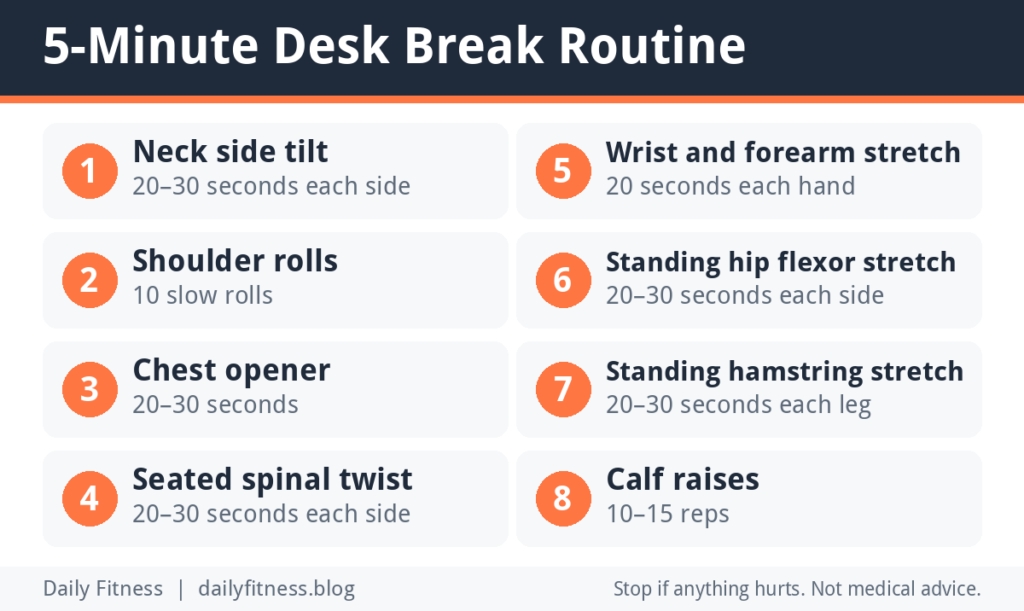
A 5-minute desk break routine
| Stretch | How to do it | Time |
|---|---|---|
| Neck side tilt | Sit tall and lower one ear toward your shoulder, keeping your shoulders relaxed | 20–30 seconds each side |
| Shoulder rolls | Roll your shoulders up, back and down | 10 slow rolls |
| Chest opener | Clasp your hands behind your back or hold the sides of the chair and gently lift your chest | 20–30 seconds |
| Seated spinal twist | Sit tall and turn your torso gently to one side, using the chair back for light support | 20–30 seconds each side |
| Wrist and forearm stretch | Extend one arm and gently pull the fingers back with the other hand | 20 seconds each hand |
| Standing hip flexor stretch | Step one foot back, tuck your pelvis slightly and lean forward a little | 20–30 seconds each side |
| Standing hamstring stretch | Rest a heel on a low surface and hinge forward from the hips with a flat back | 20–30 seconds each leg |
| Calf raises | Stand tall, rise onto your toes and lower slowly | 10–15 reps |
If you are short on time, choose four or five moves. Move gently, breathe normally and skip any stretch that hurts.
One-minute micro-breaks
- Stand up and walk to refill your water bottle.
- Do ten slow bodyweight squats.
- Look at something far away for about 20 seconds to rest your eyes, a commonly suggested tip.
- Take calls standing or while walking.
- Walk over to a colleague instead of sending a message.
Set up your desk to reduce strain
- Place your screen at about eye level, roughly an arm’s length away.
- Keep your feet flat on the floor or on a footrest.
- Keep your knees at about hip level.
- Keep your elbows near your sides at roughly 90 degrees.
- Keep your wrists straight when typing.
- Support your lower back with the chair or a small cushion.
- Change position often. Your next posture is usually the best one.
Build more movement into your day
- Take a 10-minute walk after lunch.
- Use stairs when you can.
- Stand during phone calls.
- Schedule short walking breaks in your calendar.
- Try a gentle session after work, such as daily yoga for stress relief or a low-impact holistic workout.
Common mistakes
- Stretching only when the pain is already severe
- Holding stretches too hard or bouncing
- Sitting still for hours, then stretching suddenly
- Ignoring discomfort that keeps coming back
- Relying on stretches instead of regular exercise
When to see a professional
- Numbness, tingling or weakness in your arms or hands
- Pain that spreads, worsens at night or does not improve
- Headaches that keep returning
- Pain after an injury
If you have chest pain or sudden breathlessness, seek urgent medical care.
A 10-minute reset for stiff days
- Walk for 2 minutes, even if it is just around the office or your home.
- Spend 2 minutes on gentle neck and shoulder mobility.
- Spend 2 minutes on hip and hamstring stretches.
- Do 2 minutes of easy squats or sit-to-stands.
- Finish with 2 minutes of slow, relaxed breathing. Our guide to breathing techniques for holistic health has simple ideas.
A desk-friendly strength mini-routine
- Sit-to-stand from your chair: 10 easy reps.
- Wall push-ups: 10 reps.
- Calf raises: 10–15 reps.
- Glute squeezes: 10 slow squeezes.
- Desk-supported incline push-ups: 5–10 reps if you feel comfortable.
Keep the effort easy and stop if anything hurts. For a longer session after work, try our 15-minute daily strength workout.
Eye and screen comfort
- Look away from the screen every so often. The 20-20-20 idea (every 20 minutes, look about 20 feet away for 20 seconds) is a commonly suggested habit.
- Blink regularly and avoid screen glare.
- Adjust screen brightness and text size so they are comfortable.
- Use audio-only for some calls so you can step away from the screen.
- See an eye professional if strain or headaches continue.
Stretching around your day
| Time of day | Idea |
|---|---|
| Before work | Gentle neck and shoulder mobility |
| Lunch | A 10-minute walk |
| After work | A short yoga session such as our easy yoga flow |
| Evening | Slow breathing, for example with our mindful breathing techniques |
Frequently asked questions
How often should I take breaks from sitting?
Many people use a simple rule of a short movement break every 30–60 minutes. Choose an interval you can stick with and use a timer or reminder.
Are standing desks better?
Standing can add variety, but standing still for long periods is not ideal either. Alternate between sitting, standing and moving.
Can desk stretches fix back pain?
They may ease stiffness for some people, but persistent or severe pain needs professional assessment.
How long should I hold a stretch?
About 20–30 seconds per side, with gentle tension.
Do desk stretches count as exercise?
They are helpful movement, but regular exercise such as walking, strength work or cardio is still important. See our guide to low-impact holistic workouts for ideas.
Conclusion
Desk stretches and short movement breaks are a simple way to ease stiffness and add activity to a sitting-heavy day. Stand up regularly, stretch gently, adjust your desk setup and keep up regular exercise. If discomfort persists, speak to a healthcare professional.
About the author
Saba Aziz: Saba Aziz is the publisher of Daily Fitness, a health and fitness blog focused on simple, realistic ways to stay active and look after your wellbeing. Daily Fitness covers cardio, strength training, yoga, recovery, hydration and holistic wellness, with an emphasis on safe progression, reputable sources and habits you can keep. Everything on the site is for general education and is not medical advice, so please speak with a qualified healthcare professional before changing your exercise or nutrition routine. .
Educational note: this article is for general information only and is not medical advice. Please read our Medical Disclaimer and check with a qualified professional before starting or changing an exercise or nutrition routine.
Trusted sources to read next
Related reading
- A Daily Fitness Routine for Busy People: 20–30 Minutes a Day
- Morning vs Evening Workouts: When Is the Best Time to Exercise?
- Rest and Recovery: How to Plan Rest Days, Sleep and Easier Weeks
- Low-Impact Workouts: Gentle Exercise Options That Go Easy on Your Joints