
 By Saba Aziz

Why a warm-up and cool-down matter
A good warm-up and cool-down routine takes about ten minutes in total, and it prepares your body for exercise and helps it settle afterwards. A warm-up raises your heart rate and body temperature, loosens your joints and rehearses the movements you are about to do. A cool-down lets your heart rate and breathing come down gradually. This guide gives you a simple five-minute warm-up and a five-minute cool-down you can use before almost any workout.
Research on whether warming up and stretching prevent injuries is mixed, but warming up is widely recommended because it helps you feel ready and move better. Treat it as a low-cost habit, not a guarantee against injury.
Key takeaways
- Warm up for about 5–10 minutes with gentle, movement-based exercises.
- Start easy and raise the intensity gradually. You should feel warmer, not tired.
- Cool down for about 5 minutes with easy movement and gentle stretches.
- Hold static stretches for about 20–30 seconds, without pain.
- Adjust the routine to what you plan to do: lifting, cardio or yoga.
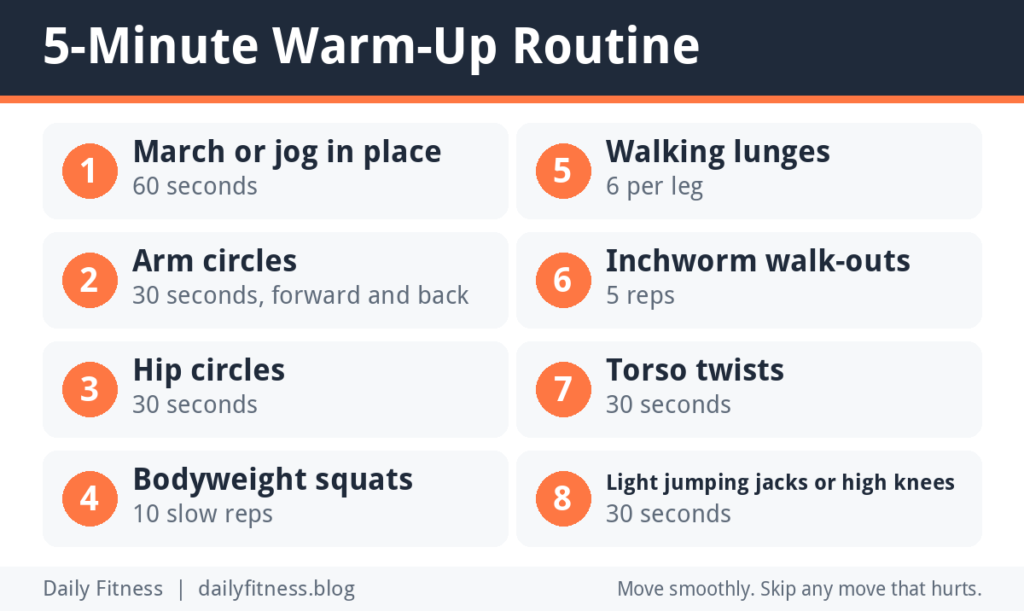
The 5-minute warm-up
| Move | Time | Why it helps |
|---|---|---|
| March or jog in place | 60 seconds | Raises heart rate and body temperature |
| Arm circles (forward and back) | 30 seconds | Loosens the shoulders |
| Hip circles | 30 seconds | Mobilizes the hips |
| Bodyweight squats | 10 slow reps | Warms up the legs and hips |
| Walking lunges | 6 per leg | Warms the thighs and glutes |
| Inchworm walk-outs | 5 reps | Stretches the hamstrings and warms the shoulders and core |
| Torso twists | 30 seconds | Mobilizes the spine |
| Light jumping jacks or high knees | 30 seconds | Final heart-rate lift (skip if impact bothers your joints) |
Move smoothly rather than forcefully. If a move hurts, make it smaller or skip it.
Adjust your warm-up to the workout
- Strength training: do the 5-minute routine, then 1–2 light sets of your first exercise. Try it before our 15-minute daily strength workout or dumbbell-only routine.
- Cardio or HIIT: start with 5–10 minutes of easy walking, cycling or jogging and raise the pace gradually. See our guide to HIIT vs steady-state cardio.
- Yoga: begin with gentle movements such as cat-cow and light twists before deeper poses. Our easy yoga flow is a good place to start.
- Cold weather or early morning: add a few extra minutes, because the body often feels stiffer.
The 5-minute cool-down
- Move easily for 2–3 minutes, such as slow walking, to bring your heart rate down.
- Calf stretch: 20–30 seconds per leg.
- Hamstring stretch: 20–30 seconds per leg.
- Hip flexor stretch in a half-kneeling position: 20–30 seconds per side.
- Chest and shoulder stretch: 20–30 seconds.
- Slow, deep breathing for about 1 minute.
Stretch only to a mild pull, never to pain, and do not bounce.
Dynamic vs static stretching
| Type | What it is | Best used |
|---|---|---|
| Dynamic | Controlled movement through a range of motion, such as leg swings and arm circles | Warm-up |
| Static | Holding a stretch for 20–30 seconds | Cool-down or a separate flexibility session |
Long static holds right before strength or power work may temporarily reduce performance in some people. That is one reason movement-based stretching is usually preferred before exercise.
Common mistakes
- Skipping the warm-up when short on time
- Going straight into heavy or fast efforts
- Bouncing in stretches
- Stretching into pain
- Stopping suddenly after hard cardio
- Using the same warm-up for every activity without adjusting it
When to take extra care
- In cold weather or first thing in the morning
- When returning from an injury
- If you are a beginner or an older adult
- If you have joint problems
Stop and seek medical advice if you feel sharp pain, dizziness or chest discomfort.
A quick warm-up for busy days (2–3 minutes)
- March in place for 45 seconds.
- Make arm circles for 20 seconds.
- Do 8 bodyweight squats.
- Make hip circles for 20 seconds.
- Do 3 inchworm walk-outs.
Mobility moves for stiff areas
| Area | Move | How to do it |
|---|---|---|
| Shoulders | Wall slides | Stand with your back near a wall and slide your arms up and down gently, 8–10 reps |
| Hips | Hip circles or hip switches | Move slowly through a comfortable range, 6–8 reps each side |
| Ankles | Ankle circles and calf raises | 10 circles each way, then 10 calf raises |
| Upper back | Cat-cow | 8–10 slow cycles on hands and knees |
| Hamstrings | Leg swings | Hold a wall and swing each leg gently, 10 reps |
How to know your warm-up worked
- You feel warmer and your breathing is slightly deeper.
- Your joints feel looser.
- Movements feel smoother and more controlled.
- Your first working set feels manageable, not heavy.
- You are not already tired before the main workout.
If something hurts during the warm-up, do not push through it. Make the movement smaller, or leave it out.
Cool-down ideas for different workouts
| Workout | Cool-down focus |
|---|---|
| Strength training | Light walking, then gentle stretches for the muscles you trained |
| Cardio or HIIT | 3–5 minutes of easy walking before stretching, with slow deep breaths |
| Yoga | Gentle forward fold, child’s pose and a short final rest |
| Walking | Slow the pace for the last 5 minutes, then stretch calves and hips |
Frequently asked questions
Do I really need to warm up for a short workout?
Yes. Even a short two- to three-minute version is better than none, especially before hard efforts.
How long should a warm-up be?
Around 5–10 minutes is a common guide. Go longer for intense sessions, cold weather, or when you feel stiff.
Does cooling down prevent muscle soreness?
Evidence that cool-downs or stretching prevent soreness is limited. They can still help you wind down and feel comfortable, and a gradual finish is sensible after hard cardio.
Should I stretch before or after exercise?
Use dynamic movement before exercise and gentle static stretches afterwards or in a separate session.
Can the warm-up be my whole workout on a busy day?
A brisk warm-up plus a few strength moves can make a short workout. Our 15-minute daily strength workout shows one way to do it.
Conclusion
A simple warm-up and cool-down routine costs only about ten minutes, and it makes exercise feel smoother and more comfortable. Warm up with gentle movement, adjust it to your workout, finish with easy movement and light stretches, and never push into pain.
About the author
Saba Aziz: Saba Aziz is the publisher of Daily Fitness, a health and fitness blog focused on simple, realistic ways to stay active and look after your wellbeing. Daily Fitness covers cardio, strength training, yoga, recovery, hydration and holistic wellness, with an emphasis on safe progression, reputable sources and habits you can keep. Everything on the site is for general education and is not medical advice, so please speak with a qualified healthcare professional before changing your exercise or nutrition routine. Learn more about Daily Fitness.
Educational note: this article is for general information only and is not medical advice. Please read our Medical Disclaimer and check with a qualified professional before starting or changing an exercise or nutrition routine.
Trusted sources to read next
Related reading
- 15-Minute Daily Strength Workout You Can Do Anywhere
- Resistance Band Strength Workouts for Everyday Fitness
- Weekly Strength Training Split: 3-Day, 4-Day and 7-Day Layouts
- Dumbbell-Only Strength Routine: A Simple Full-Body Plan