
 By Saba Aziz

Quick answer: which cardio should you do daily?
For most people, the best daily cardio is easy to moderate steady-state work, with HIIT kept to a few short sessions each week. HIIT is time-efficient but demanding, so doing it every day leaves little room to recover. Steady-state cardio is gentler and much easier to repeat, which is why it suits a daily habit. This guide compares HIIT vs steady-state cardio so you can choose based on your goals, time and body.
For context, the World Health Organization recommends that adults do at least 150–300 minutes of moderate-intensity aerobic activity, or 75–150 minutes of vigorous-intensity activity, or an equivalent mix, each week, plus muscle-strengthening activities on two or more days. Both styles of cardio count toward that total.
Key takeaways
- HIIT uses short, hard efforts with recovery; steady-state uses a continuous, comfortable effort.
- Both improve heart and lung fitness and can support fat loss when your overall routine and eating habits are consistent.
- HIIT saves time but needs more recovery. Steady-state is easier to do often.
- A mix works well for many people: mostly steady-state, plus one to three short HIIT sessions a week.
- If you have a heart condition, are pregnant, or are returning from injury, speak to a healthcare professional first.
What is HIIT?
High-intensity interval training (HIIT) alternates short periods of hard effort with periods of easier movement or rest. A session might use 30 seconds of fast cycling or jumping followed by 60–90 seconds of easy pedalling or walking, repeated for several rounds. Including warm-up and cool-down, many HIIT workouts take 15–30 minutes. Hard efforts should feel challenging, but your form should stay controlled.
What is steady-state cardio?
Steady-state cardio means keeping a fairly constant, moderate effort for a longer period, such as brisk walking, easy cycling, swimming or light jogging for 20–60 minutes. A useful check is the talk test: at a moderate pace you can speak in full sentences but could not sing.
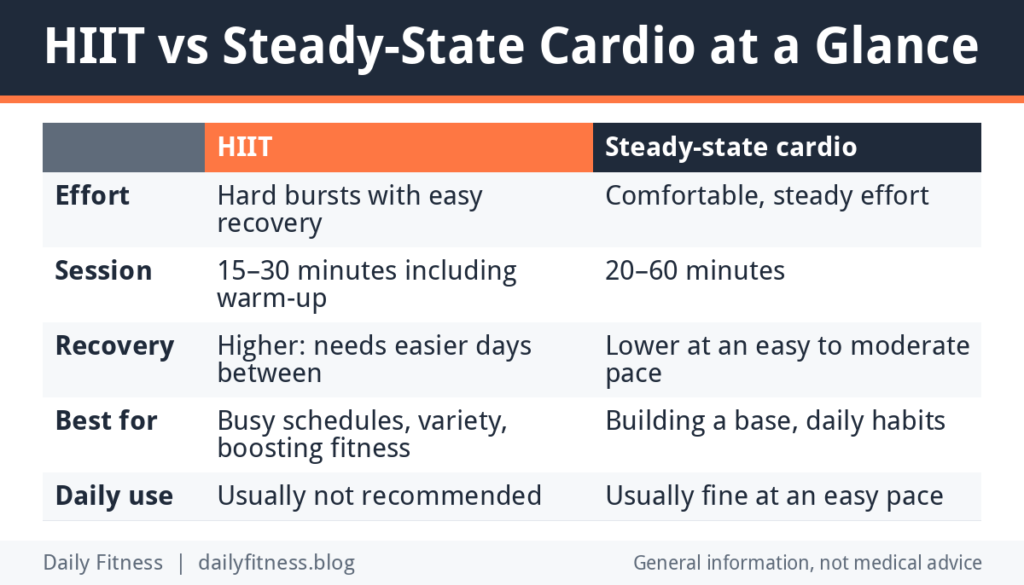
HIIT vs steady-state cardio at a glance
| Feature | HIIT | Steady-state cardio |
|---|---|---|
| Effort level | Hard bursts with easy recovery | Comfortable, consistent effort |
| Typical session | 15–30 minutes including warm-up | 20–60 minutes |
| Recovery needed | Higher; hard days need easier days between | Lower at an easy to moderate pace |
| Injury and overuse risk | Higher if done too often or with poor form | Lower, though repetitive strain is still possible |
| Beginner friendly | Only in a gentle, shorter form | Yes |
| Best for | Busy schedules, variety, boosting fitness | Building a base, daily habits, active recovery |
| Daily use | Usually not recommended | Usually fine at an easy pace |
Which is better for fat loss?
Neither has a magic advantage. Fat loss depends mainly on your overall energy balance over weeks and months, which comes from what you eat, how much you move across the day and how consistently you keep it up. Research comparing the two often finds similar fat loss when the total energy spent is similar. HIIT can be attractive when time is short, while steady-state can be easier to fit in on more days. The better option is the one you can keep doing safely.
Which is better for heart health and fitness?
Both improve cardiorespiratory fitness. Vigorous work such as HIIT tends to raise fitness quickly for the time spent, while steady-state builds an aerobic base with less stress on the body. Health guidelines count both moderate and vigorous activity, so you do not have to choose only one.
Can you do HIIT every day?
For most people, no. Hard sessions stress muscles, joints and connective tissue, and your body adapts during recovery, not during the workout itself. Doing hard intervals every day can lead to constant fatigue, poor sleep, sore joints and stalled progress. Many people do well with one to three HIIT sessions per week, with easier days in between.
Signs you need more recovery
- Fatigue that does not improve after a night or two of rest
- Worse performance than usual at the same effort
- A higher-than-usual resting heart rate on several mornings
- Trouble sleeping or a low mood
- Aches in joints or tendons that keep returning
If you notice several of these, swap hard sessions for walking, easy cycling or stretching for a few days. Talk to a health professional if symptoms persist.
Can you do steady-state cardio every day?
Yes, for most healthy adults, as long as the effort stays easy to moderate and you vary the activity when you can. Alternating between walking, cycling and swimming spreads the load across different tissues and lowers the risk of repetitive strain. Take a lighter day or a full rest day if you feel run down.
Sample weekly plans
| Day | Beginner | Fitness-focused |
|---|---|---|
| Monday | 30 minutes brisk walking | 40 minutes easy steady-state |
| Tuesday | Strength session (20–30 minutes) | HIIT (about 20 minutes) plus strength |
| Wednesday | 30 minutes easy cycling or walking | 40 minutes steady-state |
| Thursday | Rest or gentle stretching | Strength session (about 30 minutes) |
| Friday | 30 minutes brisk walking | HIIT (about 20 minutes) |
| Saturday | A fun activity such as dancing, swimming or hiking | 45–60 minutes easy steady-state |
| Sunday | Rest | Rest or a gentle walk |
A simple beginner HIIT session
- Warm up: 5 minutes of easy walking or cycling.
- Intervals: 30 seconds of hard effort (about 7–8 out of 10), then 60–90 seconds easy. Repeat 6–8 times.
- Cool down: 5 minutes easy, then light stretching.
Start with fewer rounds if you are new to interval training. Choose low-impact options such as cycling or brisk incline walking if your joints are sensitive, and stop if you feel pain, dizziness or chest discomfort.
How to choose
- Choose steady-state if you are new to exercise, want a daily habit, or are building a base.
- Choose HIIT if you have limited time, already have a base, and recover well between sessions.
- Choose a mix if you want variety and steady progress without overloading your body.
Common mistakes
- Skipping the warm-up
- Going all-out on every interval
- Doing HIIT on back-to-back days as a beginner
- Ignoring sleep and nutrition
- Leaving out strength training
- Copying someone else’s plan without adjusting it to your level
Frequently asked questions
Is 20 minutes of HIIT enough?
For many people, yes. Twenty minutes with a warm-up and well-paced intervals can be a solid workout. Total weekly activity and consistency matter more than any single session.
Which burns more calories?
HIIT is usually more demanding per minute, but a longer steady-state session can burn as many or more calories in total. The numbers depend on your body size, effort and session length. The small extra burn after exercise is usually modest, so do not pick a workout for that reason alone.
Can I do both on the same day?
Yes. Some people follow a short HIIT block with easy cool-down movement, or add steady-state cardio on a strength day. Keep the total load manageable and put the hardest session first, when you are freshest.
Is HIIT safe for beginners?
It can be in a gentle form, with short, moderate intervals and long recoveries. If you have a heart condition, high blood pressure, joint problems, are pregnant or postpartum, or have not exercised for a long time, check with a healthcare professional first.
How many rest days do I need?
Most people benefit from at least one lighter or rest day per week, and more when they are doing hard sessions. Pay attention to signs of fatigue rather than following a fixed rule.
How to measure intensity
You do not need a heart-rate monitor to get the effort right. Three simple checks work well:
- Talk test: at moderate effort you can speak in full sentences; at vigorous effort you can manage only a few words at a time.
- Effort scale from 1 to 10: easy is about 3–4, moderate about 5–6, and hard intervals about 7–8. Save 9–10 efforts for experienced athletes, and only occasionally.
- Heart rate (optional): a watch or chest strap can help, but age-based formulas such as 220 minus your age are only rough estimates, so treat them as a guide, not a rule.
Best exercises for each style
| Style | Lower-impact choices | Higher-impact choices |
|---|---|---|
| HIIT | Cycling, rowing, elliptical, incline walking, swimming | Running sprints, jumping jacks, burpees, skipping |
| Steady-state | Walking, cycling, swimming, elliptical | Jogging, hiking, dance cardio |
If you are new to exercise, carry extra body weight, have sensitive joints or are returning after pregnancy or injury, start with the lower-impact choices and add impact slowly.
How to progress safely
- Change one thing at a time: add rounds, lengthen the hard intervals, or shorten the rest, but not all at once.
- Add one or two rounds every week or two rather than every session.
- Keep the same HIIT days for a few weeks so your body can adapt.
- Take an easier week every four to six weeks by cutting volume by a third to a half.
- Keep two or more strength sessions in the week to protect your joints.
Special considerations
- Older adults: use gentler intervals and include balance work. The WHO advises older adults with poor mobility to do balance-focused activity three or more days a week.
- Pregnancy and postpartum: get personal guidance from a healthcare professional before starting or changing intense exercise.
- Health conditions or medication: follow your clinician’s advice on intensity, especially with heart, blood pressure, diabetes or joint conditions.
- Hot or humid weather: shorten sessions, drink water and lower the intensity.
Conclusion
HIIT vs steady-state cardio is not an either-or choice. For a daily habit, build around comfortable steady-state activity, add one to three short HIIT sessions per week if you enjoy them and recover well, and include strength training on two or more days. Adjust based on how you feel, and make changes gradually.
Sources
Free tool: estimate your moderate and vigorous heart rate ranges with our Heart Rate Zone Calculator. Also: set work, rest and rounds with our Workout Interval Timer.
About the author
Saba Aziz: Saba Aziz is the publisher of Daily Fitness, a health and fitness blog focused on simple, realistic ways to stay active and look after your wellbeing. Daily Fitness covers cardio, strength training, yoga, recovery, hydration and holistic wellness, with an emphasis on safe progression, reputable sources and habits you can keep. Everything on the site is for general education and is not medical advice, so please speak with a qualified healthcare professional before changing your exercise or nutrition routine. Learn more about Daily Fitness.
Educational note: this article is for general information only and is not medical advice. Please read our Medical Disclaimer and check with a qualified professional before starting or changing an exercise or nutrition routine.
Related reading
- Skipping Rope for Cardio: A Practical Daily Guide
- Cardio at Home Without Equipment: 10 Exercises and 3 Routines
- Daily Cardio for Beginners: How Much, How Hard and How to Start
- Home Cardio Workout Plan for Busy People: A 4-Week Schedule